
Ayatollah Khamenei Visits
The Family of Martyr Yermi Yagoub
Visit Date: 2002/12/8
The Photo of
Martyr Yermi Yagoub
Martyred during Ahvaz Aerial Bombing
Martyred on 1980/10/9
“Oh, father, father, father, my dear kind, selfless father, everyone tells me how a wonderfull, good person you were.
Why don’t you come back to me, when I have become paralyzed in your absence? Don’t you want to know how I am, how I miss you. Oh father, can you hear me at all? Perhaps you’re just sitting motionless in that photo-frame and watch tear-drops falling down from your daughter’s eyes?
Your daughter had just finished her university studies in the field of architecture and had just passed the age of twenty when this evil accident happened to her. All limbs in the right side of my body are numb. If a needle is pierced into these areas, I won’t feel it. I never know how this happened, no, even the best specialists do not know.
Only Raam-ll, my elder brother, who had telephoned mother from aboard, had said: “It’s because of her constant thinking and grief about our martyred father, that is the root-cause of her illness.” Some doctors are of the opinion that such an illness could only be the consequence of intense psychological suffering and chronic nervousness. Well, if all this be true, how can I stop thinking about my father? Thinking about a father whose name, after 21 years, is still on the lips of all Assyrians of Iran as a great, selfless martyr. Almost all of our families know about my peculiar illness and many come to meet me but I am not in the mood to talk to them. There’s only one person whom I’d like to meet, I just want him to come back alive, to talk to me, to ask about my health, to tell me about our common memories and to comfort me. But my mother says: it is impossible, so don’t talk about it anymore!
I am sitting in my wheel-chair with a photo of my father in my hands; I am complaining about my father’s absence. These days when I have to sit in a wheel-chair, my desire to see him again is more intense than ever. A few days ago I happened to hear the loudspeakers echoing the voice of people taking part in the Moharram Mournings concerning the martyrdom of Imam Hussein. A man was reciting some poems about Ruqaya, the daughter of the Imam and in it he kept repeating: oh, father, father, father! When I heard this, I cried and wept loudly and addressed my father saying: You left us; you never thought that your daughter needs a father!
I was only two- months old when my father was martyred. I, my mother and my brother and sister were in Tehran and my father was working in Ahvaz. It was the early days into the war and Ahvaz was being bombarded vehemently by the Iraqi aggressors. My father was an electrical engineer in charge of the Ahvaz General Department of Electricity. Most employees of this Department had already left Ahvaz but my father believed that he should stay there and serve the people. He said that now the people needed him more than before. Although he was the head of the Department, he used to go to his office at 7a.m. and worked there as an ordinary employee till midnight. He did not have the time to come to Tehran and see his new-born baby. He only had asked mother to name the baby ‘Rodrina’.
On 27th of February, which was a Thursday, he was near his office when Iraqi jet-fighters dropped numerous bombs on the city. He lies on the ground but one of the the bombs explodes not far from him; he is lit by several shrapnel pieces. When people take him to hospital, he is still alive. Dr. Alavi, a friend of his, tries to save him by a quick surgical operation. Before the operation, my father had managed to say to him: Take care of my children and tell them I love them very much. This was the very last sentence uttered by my father when he was still in this world.
The Visit
When I met that gentleman, I was a little less than 9 years of age. It was Christmas Eve. He had come to congratulate us on the occasion of our new year and hear our words about father. When he arrived, only my mother and I were at home. Ramona and Il were away. I don’t remember where they had gone. I had seen him many times on the television. Yes, he was then the President, Ayatollah Khamenei.
I don’t remember much about this meeting, I only remember that I sat very close to him as he sounded to me as a kind father. He touched my hair in a loving manner. But later two photos taken at this visit were given to me; these photos revise the dim memory of that evening. To me it feels like it was my own father touching my hair. Now the grown-up daughter of the martyr, who is badly ill, kept saying that she wants to see the same gentleman who met her when she was a child. But the mother tells her the gentleman is now the Leader of the Islamic Republic of Iran and that he is too busy and has no time to come and meet you for a second time.
I kept insisting and finally my mother telephoned the Leader’s Office shamefully and explained the situation and her request. Some weeks pass by and there is no news, so my mother said: I told you, the Leader is too busy to come to meet you; you must stop awaiting it. But I said I feel in my heart that he will come to us one of these winter evenings.
All of a sudden, this morning, the telephone rang, some people would like to come and see you this evening. In my wheel-chair I go around thinking that these visitors are the representatives of the Leader to tell him how you are. Despite all these thoughts, I chose a beautiful scarf and pretty overcoat. My mother is really anxious for she does not know how to deal with my hopes; she raises her hands and says: O God, let my daughter not be disappointed! Now the door-bell is rung, some people come in; they are talking in their walkie-talkies in low voices. Then one of them turns to me and says: No, we are not here to enquire after your health and report it to the Leader, because the Leader will be here in one or two minutes!
I don’t hear the man anymore; my heart is beating fast and my eyes are full of tears. I look at my father’s photo and say to him: thank you, now I know you’re always thinking of me.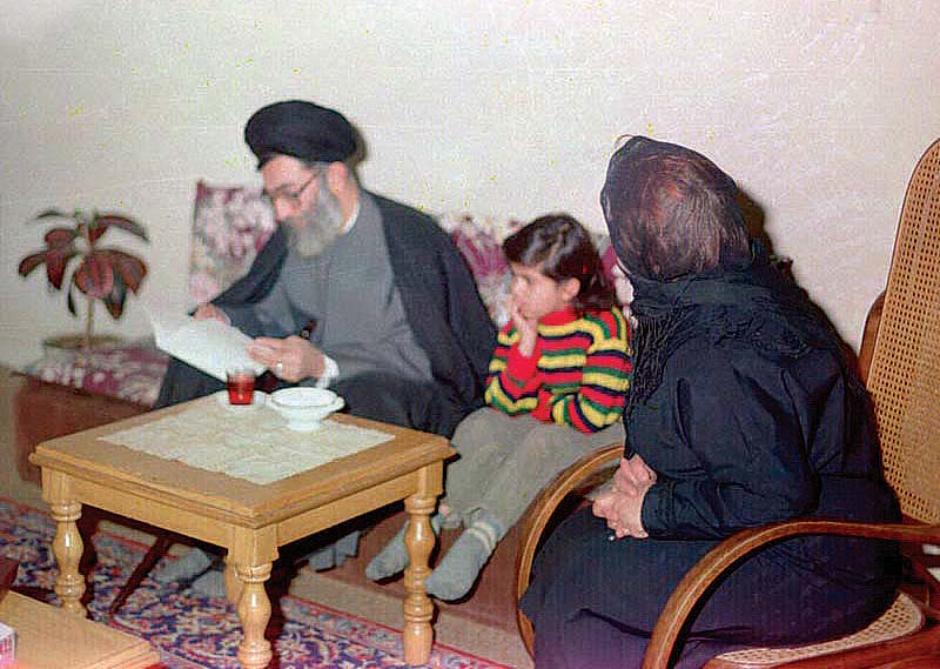
Just before Ayatollah Khamenei’s arrival, my elder sister, Ramona who is a physiotherapy doctor embraces and kisses me. She is truly happy because when Mr. Khamenei visited us for the first time, she was not at home and since she has always been very sorry.
She used to tell me: you’re lucky, you sat next to him and he touched your hair. But now after some 13 years she will have the chance to see him so closely. Our mother’s feeling may not be described. She still does not believe that Ayatollah Khamenei, despite all his preoccupations, is visiting us for the second time. No, she can’t believe it. She is grasping her cross and thanking Holy Mary. The moment Ayatollah arrives, the spectacle of each person in the room is most interesting: my mother has her hands on her chest and has tears in her eyes, my aunt has her hands stretched down and stands in a very respectable manner and I, I rise up in my wheel-chair with great difficulty but I am happily smiling.
My mother says to the Leader: We are most indebted for the favour of your visit. The leader looks around and says: Well, Well, is this the girl who is a little unwell?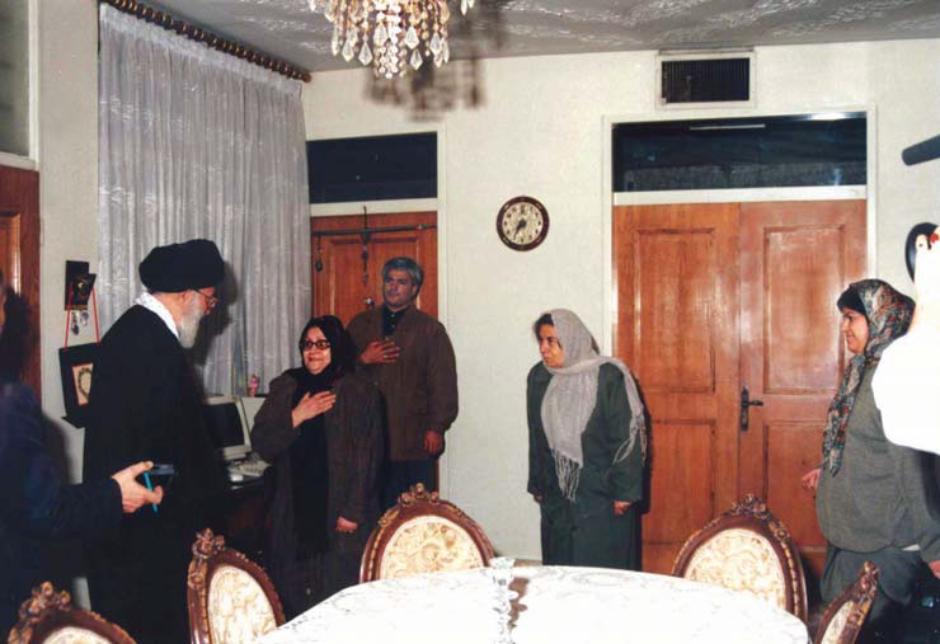 It is the first time in two weeks that I am standing in my wheel-chair; I have some extra strength at this moment. My mother says ‘yes’ to the Leader’s question and I say ‘Hello’ to him.
For a few moments he looks at me kindly and smiles and says: God willing, you’re better?
And I say: Yes, I’m alright.
And he says: praise be to God, I hope you’ll always be well.
I again think of my father and say in my heart: Oh, Father, you don’t know how cheerful I was when he asked about my health; I wish you were here too, perhaps you’re seeing all this.
Ayatollah also asks about your sister and then enters the sitting-room. My mother sits next to the Leader and I ask my sister to take my wheel-chair just opposite him. The Leader says: We decided to come and see you all as well as visiting your sister, If God will, He shall grant you patience and rewards, tolerance and strength of heart.
Then the Leader asks my mother how it was that your daughter had this sort of paralysis. And my mother describes the circumstances concerning the deterioration of my health and I listen to their conversation attentively.
My mother is a veteran nurse, a first-rate nurse in many hospitals; it was in fact in one of these hospitals when my father fell in love with her, with Miss Rouny Beth Oshana, my mother.
My mother did not abandon her job as a nurse even after my father’s martyrdom and continued her work during the 8 years of war and constantly took care of the wounded in the war who were in need of special attention. And after the war she continued her work as an instructress in nursing cares in order to pass on her experience to the younger generation of Iranian nurses.
After my mother’s explanation of her continuing good work and the hardships she faced while bringing up children at the same time, the Leader who had attentively listened to my mother, said: Well, I hope and pray that, God willing, your daughter will be in perfect health and that God Almighty will do away with your grief and worries. Of course such hardships in life are divine tests. Surly divine tests are not like worldly experiences.
The worldly tests are like examinations in schools and universities; in these tests the aim is to find out if the student has properly studied the relevant courses. But in divine tests there is another dimension: they help you to get to know yourselves better and to find out about one’s true quality and essence, and the strength and capability in one’s mind and heart; these divine tests somehow resemble sports events: they include both exercise and tests; I mean that as far as divine tests are concerned, if you don’t lose your patience and your trust in God, you shall go one step forward spiritually. This is the essence of divine tests.
Certainly there are some people who never learn any lessons from such tests and events and so they never get any closer to God. They may suffer the same as the faithful, but the faithful have their trust in God to comfort them and relieve them. That is the difference. The unfaithful have suffered the same but have gained nothing spiritually. Such tests happen for all people, in different forms. Your daughter has faced one form and for others, some different forms.
There are people who suffer no physical defect or shortcoming, but they are involved in so many spiritual, financial problems or face circumstances that put intolerable pressures on their minds, hearts and nerves; that’s why some of these people commit suicide. Some of such people abandon their ordinary lives in wilderness and absolute confusion. Such situations are much harder than those faced by the faithful. When you look at the lives of people, you realize that everyone suffers from same problems.
There are others with physical defects but have no financial ability to treat them, or cannot purchase the necessary medicaments and some people who have no one to care for them or nurse them. When Ayatollah Khamenei mentions those who have no nurses, he points at my mother as a good example and I am so proud to have such a caring mother. I was always proud of my mother but now, after the Leader’s comments, I feel most delighted to have such a mother. Then the Leader turns to me and says: I came to see you many years ago; do you still remember that meeting?
I reply: oh, yes, yes, that day was the happiest day in my life.
How old were you then? He asks.
My illness has also made it difficult for me to utter words properly but I try hard and answer: Eight or nine.
The Leader shakes his head and says: Yes, that’s life, and time flies, yes it was some 13 years ago when I visited you for the first time.
The Leader, who has an alert mind, does not want to only talk to me, so he turns to my sister and talks to her for a few minutes about her profession and later he asks my aunt about the Assyrians living in Hamedan province. A little boy is sitting next to the Leader; he is his grandson who has accompanied him in this visit. It’s very sweet to me to watch him next to his grandfather.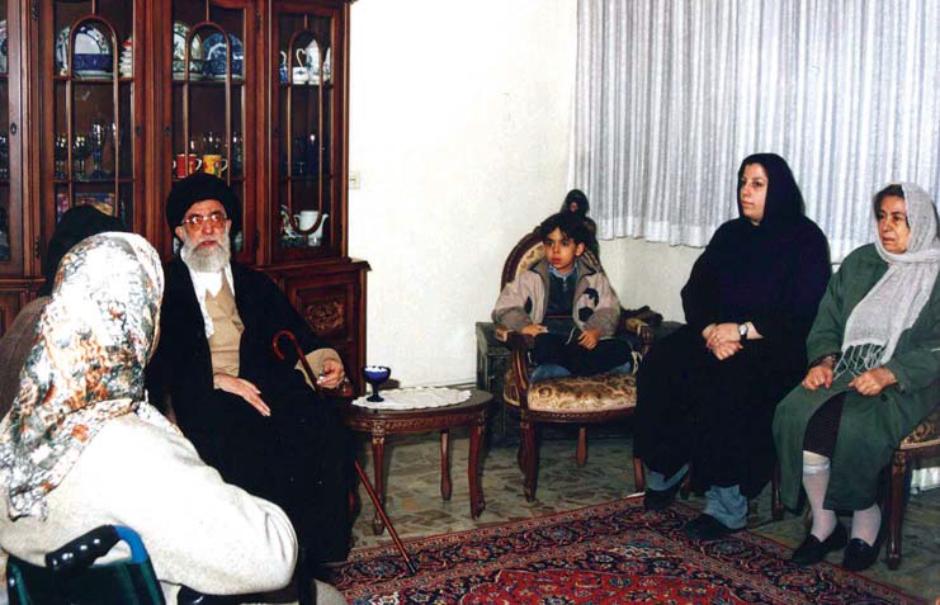 The Leader then asked my mother about Churches, the Christian-Assyrian religion and the number of Assyrian community in Tehran and after my mother’s comments, he turns to me again and asks: Do you have any pain, my daughter? And I say: “No, I have no pains,” as I meant to relieve a father from worrying.
ـ How did you learn to walk by the aid of crutches?
My mother explains that she has no senses in one hand and therefore she cannot manage to walk on crutches.
The Leader adds: I see, your right hand has no sense exactly like my right hand! He then raises his hand and smiles and asks: Do you like to hear the story about this? Yes, of course, I say.
The Leader then gave us this account about that accident: After that assassination attempt when a bomb placed in a tape-recorder exploded in front of me, the right hand became paralyzed and for some long time it did not move at all and it was swollen all over. Later on I noticed that there was some movement in my right shoulder. The doctor told me to try to move my hand when walking. Gradually the space for movement became a little wider. After some time I found out that I could bend my hand from the elbow. Those days my first daughter was born by the Grace of God. This girl was most precious to me and later she used to come to me at the Office of the President. I noticed that I could embrace her even with this senseless hand. Once my doctor saw me when I was holding her. He encouraged me to do this more often and said: This child will help your hand to become O.K.! He continued: When you hold this girl, because you love her, you do bear the heaviness. This was to be true, so I frequently held her in my arms and carried her here and there. Gradually my right arm became stronger. Now my hand, from the wrist to the fingers has no sense, it only looks like a hand! Very little things it might perform. Well, it’s a hand any way! And I recommend to you that you could also do things through exercise, practice and patience.
From the moment the Leader mentioned his sufferings after the assassination attempt and his inability to do things with both hands, I lowered my head, looked at the carpets on the floor while deeply impressed with his account of the incident. The Leader asks me again weather I have any pains anywhere in my body and I say that I have some pain in my right shoulder. He then prays for me and says: I too bore intolerable pains. For a few years I did have very severe pains. There are all sorts of pains. I hope and I pray to God that your pains will lessen and we will be witnessing your complete health.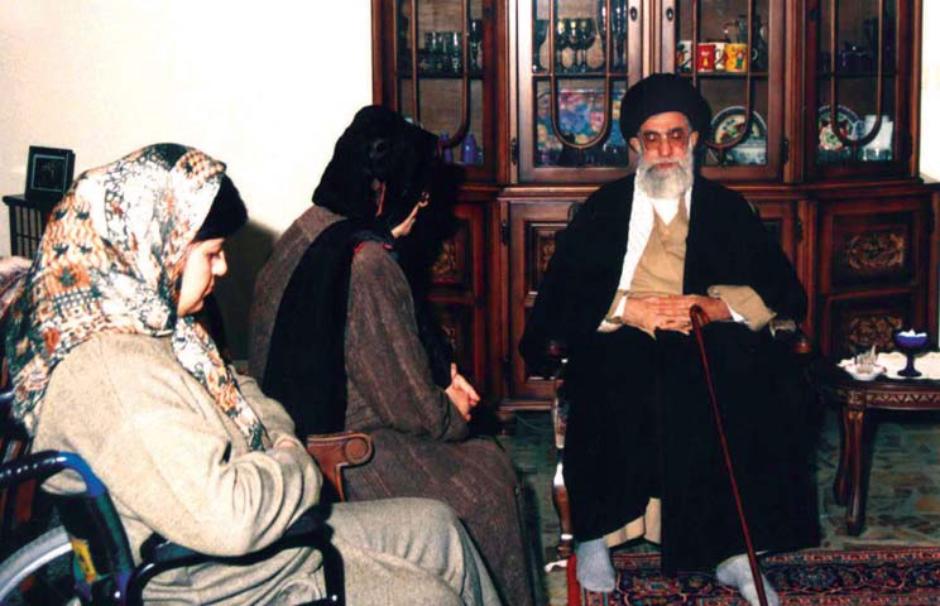 He then starts drinking his cup of tea which Ramona had brought while he was talking.
After drinking his cup of tea, he enquires about my maternal uncle who was a skillful surgeon. He was such a noble, gentle person: The Assyrian community elected him by some 99 percent of votes to be our representative in the Parliament (Majlis) as well as in the Constitutional Assembly of Experts.
The Leader says: This Mr. Beth Oshana who was in the Majlis was your brother?
My mother says proudly: Yes, he was my brother!
The Leader says: yes I knew him, he was such a knowledgeable, kind gentleman, yes I was acquainted with him.
Towards the end of the visit, the Leader said: well, the purpose of our visit was to extend our affections once again to the family of a respected martyr and to you all. And this time it was meant to see this daughter who has fallen ill thinking of her valued father. I again pray to God to relieve your pains, to grant you more trust in God, and more self-reliance to cope with existing problems, and if ever, there was anything I could do to help, please contact our Office personnel. We are always at the service of the martyr’s families.
When the Leader uttered these words, we realized that it was time to say farewell. My mother asks the Leader if I could be sent abroad for treatment. The Leader says that we have highly specialized hospitals in Iran, but if your problem is not solved in these hospitals, we would certainly help you go abroad.
***
Now Ayatollah Khamenei is gone and I have mixed feelings of happiness and sadness. I am happy that my mother, sister and aunt were so delighted to meet the Leader. And I’m sorry that he’s gone. He was as kind to me as my father. It’s only half an hour that he left us and I’m already missing him badly.